

Journal Archive
July 1996
1 July 1996
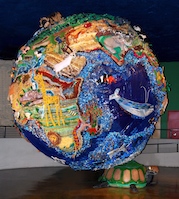
Studio visitors have been busy making lots of animals for the earth. We have 20-some animals finished.One of my favorites is a cobra designed by a four-year-old from India. She came to the studio with her two adopted mothers and two sisters. One sister is from Honduras, the other is from Russia. Each child brought something from her country to incorporate in the globe. The Indian girl brought three colorful Indian baby bangle bracelets, which wound up around her cobra's neck. The snake's body is an old tie, and we made its sharp fangs out of white plastic forks.
Another of my favorites is a pink flamingo made by a 13-year-old named Jose. Its feathers, carefully constructed of pink plastic straws, are what make the flamingo so special. Jose's family is Mexican, and lives in the neighborhood. He came to the studio with his mother, who speaks no English, and his seven-year-old brother, who tried to interpret for us. Jose is completely deaf. The family seemed to have its own hand signals to communicate -- with much pointing and head shaking.
All this reminded me that, when I am in deep concentration, I don't think in words. I tend to tune out the conversations around me, and I don't talk much. This night I became particularly aware that each of us was communicating in his or her own unique language, none of us capable of fully understanding the others, yet all of us finding plenty of opportunities to laugh. We sat close together, each working on a different project, but I had the sense that we were all in sync, all somehow on the same wave length.
5 July 1996
Today was just as fun as I thought it might be.Elena Morrales works upstairs at the Family Focus Center. Since she had the day off, she brought her husband, her in-laws (ages 65 and 70), her cousins (ages 12 and 15), and her kids (ages 7 and 16) to the studio. Elena and her husband's family originate from Lima, Peru, but the other relatives are visiting from California.
The family (minus the teenagers) had stopped by on Wednesday to check the project out and see if they wanted to help. I had asked them to tell me what was special about their country and which animals were most important there. High on their lists were the Guano islands on the coast, the cold water currents, anchovies, the condor, the puma and quinoa. They had many ideas of things from their home they wanted to show me, so decided to return on Friday, today.
And today, the whole family came, all excited to help work on the continent of South America. Wednesday, I had been designing the different surface textures to define the various habitat regions.
- In the farmlands I am sewing little rows of grains in vinyl pockets. Elena brought me a box of quinoa, a grain that is most important in the Andes.
- The mountain ridges will be defined by the many keys I have collected. Just strung next to each other they are too heavy, so I am spacing them out with buttons and beads, using brown and green for the lower ranges, blue and white for the higher peaks which might have snow. The buttons add nice color and texture. Elena also brought me a few buttons.
As the family descended into the studio bearing all these gifts, it seemed they were all talking at once, while showing me what they had brought. The hard part for me was trying to listen to their stories, explain the project to the new teenagers, and get all these different people set up at the same time. Generally, I start with the youngest in a group because their attention spans are usually the shortest.
This was seven-year-old Gabby. She has been to the studio several times and has already made two animals, so I put her to work stringing keys and buttons for the mountains. She wasn't thrilled with this task, but the adults also helped until I could get them going on other things.
The men were given the job of constructing a lip for the whole continent -- which involves attaching a 12-inch strip of chicken wire to the edge, quite a lot of trimming and bending.
The twelve-year-old had started a snail during a previous visit, so she was let loose exploring materials for that, with the help of her grandmother.
The boys (15 and 16) decided they also wanted to make animals, eventually choosing a hyena and a condor, but it took some time leafing through the library to make that decision and to find appropriate pictures.
Meanwhile, Antarctica still needs a little work. I designed a glacier with white plastic forks which have been tacked down with glue, but needed sewing down. It is a fun, easy embroidery job, so Elena got busy on that. When the snail was finished, I showed Jessica and Marta how to sew and weave light blue fabrics into the chicken wire around the edge of Antarctica to make the icy ocean edge.
At the end of the day, a lot of work had been accomplished and people seemed to have really enjoyed themselves. The men finished building the lip around the continent, and the boys are planning to return on Monday to complete their animals. The others want to weave more ocean outlines.
With four different tasks going on, and Spanish being spoken most of the time, I found myself going from group to group to help with trouble spots -- and unable to sustain individual conversations. But now that they know more what to do, I look forward to learning more about them, and their lives in Peru.
12 July 1996
Today we finished Antarctica and hung it from a pulley system in the middle of the room here at the studio.It's great to have a finished piece to show people. I have everything finished in my head, and I think I can clearly explain what my plans are, but I don't think anybody else really understands until they see it finished.
My mother is a classic example. She's heard me explain the ideas many many times, and she has been working with me from the start. Still, when we hung Antarctica, she stood in the doorway and said, "Now I see it!" She stood staring for a while and finally exclaimed, "This is amazing, I never imagined it would look like this!"
15 July 1996
Today I had planned to work alone, but I had visitors.When they arrived, I was concentrating deeply on how to finish South America, and wasn't really thrilled to have company. But I couldn't just turn away two mothers, a seven year old, and two five year olds, one of whom has severe attention problems. I was told he is "nearly autistic," and I'm not sure what that means. But he definitely has his own world. He was a curious and constant roamer of the studio, but very delicate--not loud or destructive like many "normal" kids his age.
My visitors stayed for nearly two hours, and in the end, we really got a lot of work done. One mother and two of the kids designed three fantastic animals: an arctic fox, a buffalo and an elf owl. We started outlining North America, and I decided how the ocean will meet the continents. There will be five temperature regions in the ocean with different colors of blue, which I have been needing to think about. I worked with my special curious, roaming assistant to sort out some of the many miscellaneous boxes of blue into five colors. We also marked the patterns on the globe so we know where they will go.
One of the biggest challenges in community art is to figure out who can do what, and how everyone can really be a help. One of the tricks for me is to be flexible about the order in which they happen. The things that got done today were not the things I thought I wanted done when the day started, but they all needed doing and were a BIG help. The best part is, we all had fun.
16 July 1996
Yesterday, as I shaped the Andes of South America, I thought it would be nice to incorporate some fabrics of the area. Our globe will not have political boundaries, but I would like the continents to somehow reflect their individual cultures. Using small pieces of fabrics in the background is a good place to start.Today I was given two very special gifts. The first was a finely woven brightly colored 8-inch-square-piece of fabric from Lake Titicaca. I hesitated to accept it, but the donor said it has just been in storage many years, and she would like for it to have a nice home. It will be incorporated into my Andes, and will really bring life to the mountain range.
My second gift was some "Peace Fleece." That's wool that is sold locally by a woman who makes it by purchasing both Russian and American fleece which she then spins together into fine yarn. Volunteers then crochet and knit various garments with the wool which are sold. The money is used to purchase more Russian and American fleece, providing jobs in both countries in the name of peace. The literature, label and wool samples will be incorporated into special "Peace Fleece Sheep" for both countries on our globe.
17 July 1996
Sometimes writing these updates gets tricky. Not everything that happens in the studio is appropriate to share with the whole world.Some really personal things happen with people that I don't feel I have the right to talk about. I'm an artist, not a therapist. But sometimes, when people take time to stop and be part of the creative process, things inside just open up.
I just listen as I work, and encourage them to keep helping.
23 July 1996
Two very exciting things happened today.First, I discovered (with the help of my janitor friend) that there were two dumpsters full of beautiful clean clothes just outside the door. With a little inquiry, I found that they were from a dry cleaners that had a warehouse of things they needed to empty. No one knew what to do with the ones in the dumpster, so they said it was all mine.
Courtney (my new fantastic 14-year-old assistant) and I called a couple of friends and this afternoon we had a dumpster party, hanging everything on a nearby fence. People came and took things by the armloads. It was delightful to watch people rave at their new finds.
The dumpster party was a lot like fixing up my studio. I just collected things of interesting color and texture. They were washed, sorted and arranged neetly in a rainbow of colors. Now, when people walk in, they are in awe of my treasures.
The second great thing that happened today was that we hung South America in the studio. This is the continent that we will see the best on our finished sculpture because it will be more at eyelevel. The globe is so large that the northern hemisphere will be hard to see, so South America is very detailed. You can clearly see the rain forest, the Andes, desert area, grasslands, farm land, and many animals.
Today we had many special helpers. Courtney will be a regular volunteer for the next few week. She lives with her aunt in Kansas, and takes the bus every morning. It is her first real volunteer job. She is always on time, dresses very neatly, and has an enthusiastic attitude. She is learning a little about everything. It will be a big help to let her give studio tours, and answer my pager when the studio gets busy. Today she learned how to weave.
Danny (11), is a fine young neighborhood artist. He started working on a great cow for North America. Kalah (my other fantastic regular helper who is a student at the Art Institute) came to spend time with her mother, Nora, who is a nurse visiting from Minneapolis for a few days.
All in all, our project is coming along fine. I enjoy documenting the process, but am not getting any response from our home page. If anyone is reading and following our project, your thoughts and comments would be greatly appreciated.
- Thank you,
- H.
31 July 1996
Many exciting things have been happening which I have neglected to write down. Now I will play catch up. Here are a few irresistible stories:
A Special Friend, and Hints About What Will be Next on Holly's Agenda:
Thursday the 19th, Chloe, Heinz, and Franz visited the studio from Germany. They were on a long tour of the United States, and just in town for the Jazz festival that weekend. Chloe is French, but also speaks Italian. She volunteered to come back the next day to translate my Italian letters. (see
journal entry Tuesday June 11, 1996). These letters were written by approximately 60 young teens living in a small mountain town in northern Italy. They had many enthusiastic comments about my work, asked good questions, and said they hoped I would travel through their town and do a project with them one day.
Chloe wrote a very nice letter of response for me, for which I thanked her profusely. We hugged, and said good bye as she and her friends were headed on a road trip to the Olympics.
It was a great surprise to see Chloe walk into the studio the next Wednesday (July 24). Chloe and her partner, Heinz, spend a great deal of time traveling on business. She enjoys it immensely, but for the first time in their seven year relationship, Chloe decided to tell her friend to go on without her. Chloe would spend the rest of the week working with me, and take a plane to meet up with Heinz and Franz Saturday night in Atlanta.
We had a fantastic three days. She made a zebra out of zippers, learned to weave desert and Savannah on the loom, helped work on ocean, and helped with numerous kids in the studio. Chloe is very good with her hands, but just hasn't taken time to pursue her talents in this area. Her enthusiasm and inquisitiveness were delightful to be around.
After three days, her mind was clicking not just on how to facilitate my Italian rendezvous with my fan club, but on how she could organize a project for me in her town in Germany as well.
Meanwhile, Heinz is planning a mountain bike adventure on the world's highest road in the Himalayas for September of 1997. I've been invited, and look foreword to it. Chloe says she'll ride the jeep along side, but we might get her on a bike yet....
Time's up, more later.


